
Morgan Larson, Writer
Everyone has their own learning styles and preferred learning environments. It’s these areas that allow us to take in information more thoroughly and grasp what is being presented when it comes down to choosing between online and face-to-face learning.
I prefer face-to-face learning where everything and everyone is within reach and concepts and ideas can be shown/presented in a way where my comprehension level is at its peak. With this concept freshly put out on the table, the opinions on this matter are waiting to be dished out.
One Iowa Lakes Community College (ILCC) professor who, before and is currently affected by COVID, has had his fair share of experience with both learning environments. As well, as a fellow ILCC student who voices their opinion on this topic and demonstrate their facts to help solidify where their comprehension level stands compared to my own and why they stand where they do.
For me, from face-to-face learning environment standpoint, is purely based on my experiences of having visuals. My high school business teacher, Mrs. Villeneuve, structured her learning style based on pictures, verbal communication and step-by-step processes that enabled me to strive in that particular subject area.
What was interesting was how others in my graduating class could not grasp that learning style and apply that to later face-to-face classes, even when online options were becoming more readily becoming more available to choose. Although online learning has impacted me to earn a portion of my high school degree from a place that is physically two hours away, I am convinced face-to-face structured my learning ability to adapt more to how things are physically done or applied to in the real world situations.
In a pre-COVID world, the evolving aspect of online learning was starting to take off as a new outlet toward more educational avenues. Yes, you can gain social interaction between peers in online environments, but there is something about having a physical presence in the classroom that seals the deal.
There is a significant difference between having clear points of view in a high school learning environment and a college learning environment. I believe I am the most engaged within my face-to-face afternoon classes I am currently taking at ILCC. Being a part of the action by handling the LIVE cameras and being a part of the production team for the “Coaches Show” is something one can’t learn online. This has been the most rewarding concepts to why I feel face-to-face is better than online.
When it comes to picking courses to ensure my comfort level and factoring in that I am at my best learning advantage, I usually steer toward face-to-face environments. If classes at the college are not available face-to-face maybe be due to COVID regulations, online is always that close the second option. It does provide the convenience of pushing out more classes each semester than face-to-face, but the environment would not be the same for me.
A good example I find between face-to-face and online is the material for coursework. I need the physical books in front of me. The turning of the pages, highlighting and bookmarking enable me to understand the material over viewing it online where I can not do those things and lose my sense of learning the material presented.
A face-to-face learning environment does seem to profoundly affect my lifestyle and how I conduct myself in the real world and take on situations. Adapting to new situations by applying your learning style can either make or break how you handle its outcome. The visuals of face-to-face and developing more in-depth communications skills are essential to life as humans, in my opinion.

ILCC professor Drew Howing, the Environmental Studies and Water Quality Technician Professor and Program Coordinator, expresses what his own individual learning style preference is and how online and face-to-face learning has been like within his classroom and his programs curriculum.
Before COVID-19 made its grand entrance, Howing provided an insight into his teaching styles, both online and face-to-face. “We met for 3-1 hour lectures each week and once for 2-3 hours for classes that had labs. Lectures were very interactive and more like what I would call a “guided discussion” regarding the course material,” said Howing. “In the lab, we would go over an introduction, cover what the labs’ outcomes are, and then conduct the procedure. Many of these procedures were done in the field. Upon completing the procedure, students then answer a series of “analysis questions” that I use to assess their understanding of the material,” he added.
With the ongoing affects COVID-19 has virtually put on everything, Howing believes his teaching environments towards his students have impacted the current learning environments. “The teaching environment pre-COVID was much more interactive and engaging,” Howing pointed out. “Now, I get minimal responses in online lectures, and students have not built relationships with each other for participating as a team in face-to-face lab.”
All in all, Howing would prefer a learning environment that was face-to-face but without the need for masks. “I think having students in a setting where they are in front of their peers and interacting with each other provides the greatest educational opportunity. Students challenge each other more and share their experiences. Online classes create a barrier where this type of environment doesn’t exist,” said Howing.
He finds his students are meeting the requirements with discussions and showing that they are learning the material. “But the edge of face-to-face communication leads to better discussions. I learn more in face-to-face classes as well from my students. Also, the relationships built amongst students make the learning environment more comfortable, and students open up more,” said Howing.
From Howing’s perspective, the benefits and downfalls are present in comparison. “The benefits are well-explained. Besides, face-to-face labs are considerably more advantageous because I get to be there with them to help with any questions along the way,” said Howing. He also added that he finds a number of additional learning opportunities that present themselves from student to student when asking questions in the field. They would not occur when they are doing these assignments on their own.
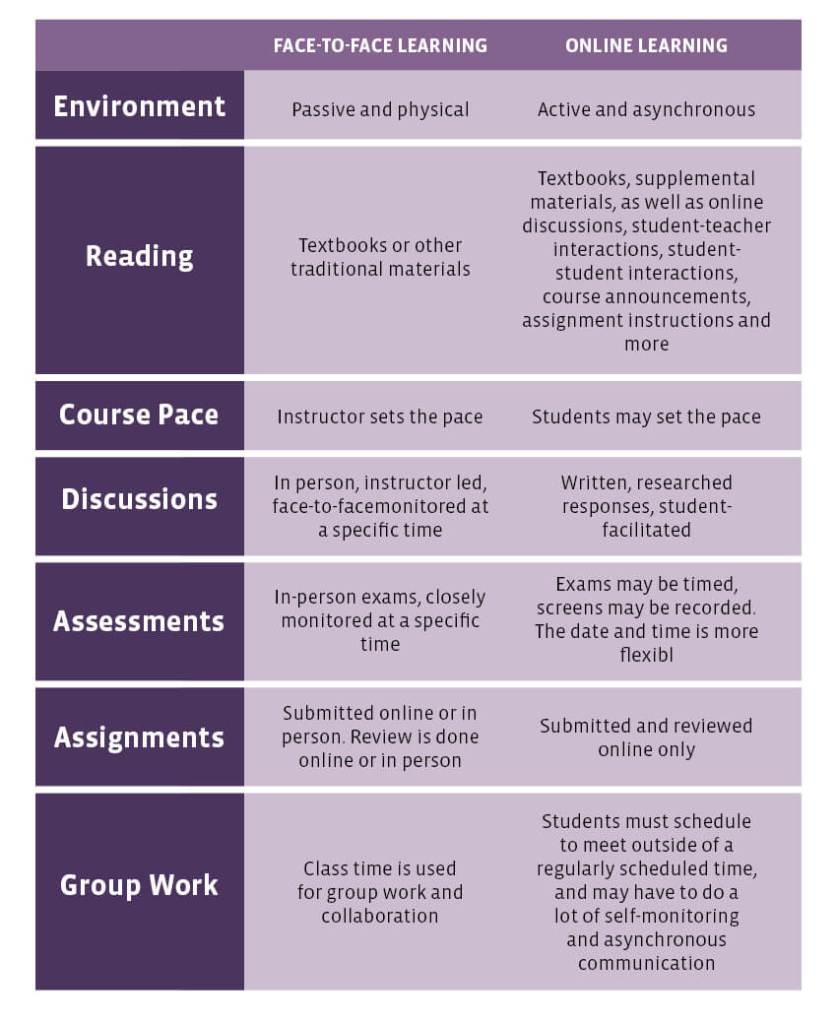
“One benefit from the online option is the flexibility for students who are working, raising a family, or are athletes” said Howing. “They get the opportunity to join lectures without having to be physically present.” He goes on to add, “I think offering lectures as optional face-to-face for these students who want to go to school but have busy schedules is one benefit. However, if at all possible, I think they get the greatest return on their investment when being physically present.”
With everything COVID-related and how much things have had to change and adapt, Howing believes that only one thing has changed in his opinion from online to face-to-face. “The only change I have seen (which is a big one) is just the lack of opinion,” said Howing. “Students are not engaging anywhere near the level that they do in a face-to-face setting. Questions I ask during lectures go unanswered, and rarely ever does a student have anything to add behind the screen. Still, when in person, we can have much more meaningful and productive conversations,” he added.
Within Howing professional opinion on whether he feels his overall preference would impact students as whole or just individual students, he had this to say, ” I believe this preference benefits students. Face-to-face labs are essential, and so are the lectures. This is, in my opinion, a much better learning environment. I am currently an online graduate student and have learned material surprisingly well. It has depended on what the professor wants to put into the activities to make them exciting and engaging.”
The learning environment has been much better than Howing would have expected, but he has experienced the shortcomings of this option. To an environmental degree, everyone needs to be out in our environment learning about it, just like a CJ student in a squad car, an aviation student in a plane, and an ag student on the farm.
Howing believes it’s what makes attending a community college so advantageous. “We engage our students at a very high level and build personal relationships that allow professors to advise a student’s future career very well,” said Howing. “Some of my professors have offered labs where we have to go outside and collect data or make observations. I integrated the same idea when we had to go completely online.”
When students were home full-time and often very isolated, this offered an opportunity for them to go outside and get active while engaging in a learning opportunity. “I have only taught for four years now, and in the last year, my students have been far less engaged during the online course offering than the three years prior. The disconnect in online lectures spills over to a lack of engagement in labs. They have not built relationships with each other at all.” Howing concluded.
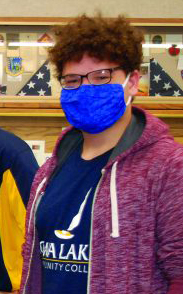
After filtering the perspective of a professional within the online and face-to-face learning environment, one ILCC student gives us a glimpse of his standing of preferred learning style. Isaiah Banwart, bringing in the final tally for one who prefers face-to-face classes.
It’s important to understand whose teaching style enabled Banwart to develop and grow within his preferred learning style. Banwart says that Mark Zabawa, an ILCC professor on the Emmetsburg campus, influenced his preferred face-to-face learning style.
“Mark is probably the first that had a face-to-face learning class that had a way in which it was conducted that was very interactive with the students,” said Banwart. “One of the things that I feel is he always takes all kinds of questions. So out of a fundamental level of people seem to ask questions, and it’s a lot harder to get people to do that over a computer,” he added.
Most people can turn off their screen, but that’s one reason online learning is sort of the versatility it provides you that if you’re like Banwart, who lives away from the campus. Sometimes with the weather getting it is tricky, it’s easier to sign in and do Zoom meetings.
“What Zabawa did when COVID started was interesting. I was in chemistry at that point, and you have a lot of labs in that class, and what he did was front-load the labs,” Banwart commented. “Which means if you do all the labs at the start of the semester, just in case something happens later because of the way of everything that’s graded, the labs are super important. As long as you have those done, you will pass the class essentially, and so he would hold on to those budget periods,” said Banwart.
Banwart’s face-to-face presence stems from his experience with how being in a room with professors/instructors and students has more of a versatile aspect. He believes that his part on this can mirror his interactions with Jason White’s two classes on Tuesdays and Thursdays and LIVE games on various other days. “They are a lot of fun,” said Banwart.
When picking his classes while attending ILCC, Banwart had this to say when choosing courses to fit his learning environment, “It depends on my schedule. There are times where I may be looking to save money on gas by going for an online class. Without so many other factors present on that, normally I do prefer to go for face-to-face on that register.”
While Banwart’s opinion on face-to-face seems to have adequate backing information, Isaiah doesn’t dismiss online learning entirely when he compares his preference over the other. “It’s handy. It has its uses, but I’ve never wanted specifically to do that,” said Banwart. Computer learning probably runs the risk of basically falling into the same issue, and just the more one must do it. When someone is moving around like Banwart does, completing computer classes from different areas of in other parts of the school, are the sort of things that just helps with the little stuff like that.
On the other hand, Banwart gives us an insight, from his point of view, into why it’s difficult online than face-to-face, “It’s just harder to get invested in a class over the screen if anything. Maybe it’s atmospheric. It’s probably different for everybody, but for me, it’s probably atmospheric to need that separation,” Banwart commented. It’s trying to get everything out at the same place on the same laptop.

“It’s not fun, and granted, the worst was probably last semester, I did a math course over the computer that was every day, and that was the semester my dad died, and my mother had surgery, so I didn’t get a lot of the material.” “I think that would have been different by then if I was in a classroom,” Banwart said.
After completing his educational career at ILCC, Banwart feels his learning environment he has benefited from will be quite influential when he walks out into the real world. “My learning style influenced my life and my future,” said Banwart. “For example, the other day, I was doing a different type of job. I helped package up food, and I needed specific items in each bag and that sort of thing. The man, in the beginning, tried to tell me them all like orally, which was confusing, so I immediately knew that’s not the learning that’s going to help. I ask him to make one to see it, study it for myself, and do that. Right away when you know what types of learning would and not work for, you can skip past that and save some time.”
It shows how each of us can draw out various points that back the face-to-face tally against the online learning field. Although we are not knocking out the concepts and benefits online learning environments provide, each of us happens to be drawn to face-to-face learning.
Most of us are visuals people, which works for us; for others, a computer resources’ simplicity to complete assignments and class time participation work is just as efficient. Even the way professors execute these environments the best they can to find out what works for them and their students with the material they provide. It’s incredible how we humans filter out information to which can people deem credible and valuable to help them in life and real-world situations.
It all starts with finding what works for you and go from there. It’s up to you to carve out your outlook on life and how you learn from it. It’s about gaining your knowledge on how and where you experience from. I can gladly sit here today and say that ILCC has provided a great atmosphere that enables me to contribute to the value of face-to-face learning even during this time. It’s developed a new kind of social interaction with set restrictions for the time being. All of us can strive to be wise which is what makes each of us Laker Proud.

 Call of the Lake
Leave a comment