
by Adam Gellert
Football is an American past-time, enjoyed by just about everyone in the country. Fans gather together, often times outside the gates of the stadium to tailgate before the game. These fans and traditions aren’t just limited to the NFL, as college football has a substantial fanbase as well, with games also receiving major sports network coverage. Like any big event with media coverage, fans often bring home-made signs to support their team. These signs can be as simple as a cut-out of a letter “D” and a small cut-out of a section of a fence, or can get even more cheeky.
One of these cheeky signs was brought to the Iowa vs. Iowa State game covered by ESPN’s “College GameDay” by former Iowa State student Carson King. One of the aspects of college football also may or may not include adult beverages. The 24 year old decided to make a light hearted joke with his sign, reading “Busch Light Supply Needs Replenished” followed by a Venmo account.
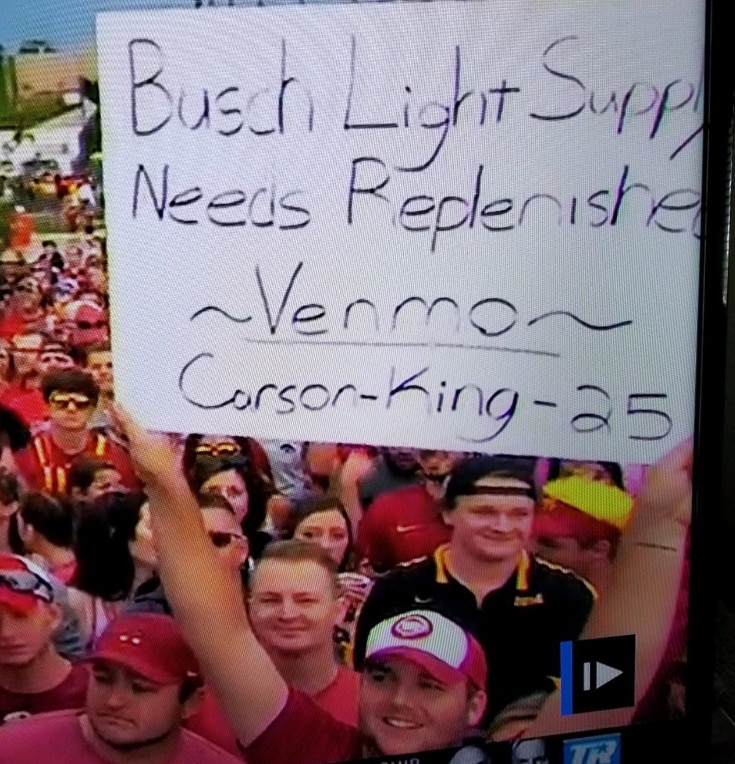
According to the Washington Post, King only expected that maybe someone would chip in a couple dollars as a joke, but the sign ended up going viral, and the account had reached near $400 only an hour after the sign appeared on ESPN. From there the funds kept growing, and had hit $270,000 dollars a week later.
So what did he do with this windfall? Some people would put the money away in savings, or perhaps buy more beer than anyone has ever seen, but King had a different idea. With the exception of $15 (to buy a case of his favorite beer) he promised to donate the rest of the money to the University of Iowa Children’s Hospital and Clinics.
Word spread about King’s impromptu charity fundraiser, and quickly gained popularity and more people and companies donated. The producer of the subject of the original sign, Anheuser-Busch, learned of the charity, and agreed to match the amount of money gained by the Venmo account. Venmo itself also pledged to match the account total as well, so the grand total was growing fast.
Anheuser-Busch also planned to supply King with a year’s supply of beer, which would have his face printed on the cans with the title “Iowa Legend” printed beneath the photo. These cans were also intended to be sold nationally as well. With the amount raised for the children’s hospital growing to over a million dollars, King was truly becoming an Iowa legend, but with great popularity, usually comes great controversy.
Des Moines Register reporter Aaron Calvin wrote a profile about King, and through a routine background check, discovered some unsavory tweets making racist comments that King had made in 2012, as a 16 year old. After making this discovery, Calvin brought the tweets to his attention. King was appalled by his old tweets, saying they “made him sick”.
“Once he pointed it out and I went back and looked at it I was really upset with myself,” King said on Twitter.
His explanation for the tweets was that they were jokes among his friends about the show “Tosh.0”.
Calvin himself didn’t think the tweets were an accurate depiction of King’s character. Calvin described telling King about the tweets in an interview with Buzzfeed.
“He was deeply regretful, and I recognized that these were not representative artifacts of Carson,” Calvin said.
King set about holding a press conference to address the tweets. He apologized for them and announced that Anheuser-Busch had ended its partnership with him over them. Although the beer company wouldn’t be going through with the year’s supply of beer and “Iowa Legend” cans, they instead added the monetary equivalent (around $500) to the more than $350,000 they had already promised to donate.
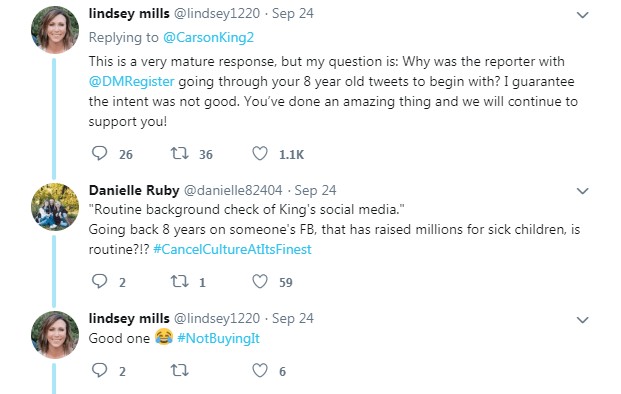
The Des Moines Register published its profile, including the information about the tweets, hours after King’s press conference. The piece sparked some outrage online, as some people blamed the Des Moines Register for the end of the Anheuser-Busch partnership. The situation was becoming the latest case of “cancel culture”.
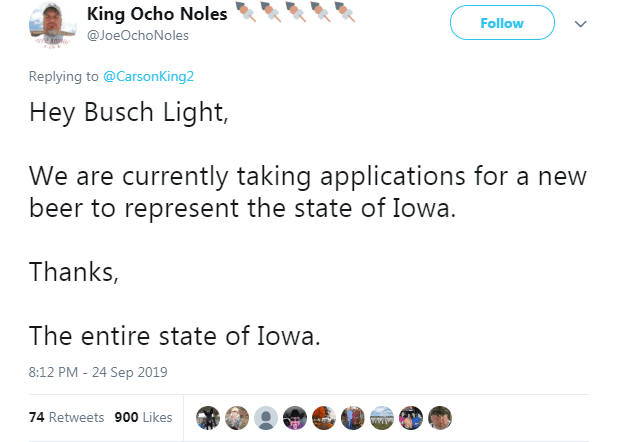
While the Register is taking the brunt of the backlash, the news organization wasn’t the first to report on the tweets. Local television stations airing King’s press conference originally broke the story. Amid the online furor, the Register re-iterated that their piece including the tweets wasn’t published until several hours after the announcement of the end of King’s partnership.
Des Moines Register executive editor Carol Hunter stood by the decision to include the tweets in the story.
“The jokes were highly inappropriate and were public posts. Shouldn’t that be acknowledged to all the people who had donated money to King’s cause or were planning to do so?” Hunter wrote in a tweet. “The counter arguments: The tweets were posted seven years ago, when King was 16. And he was remorseful. Should we chalk up the posts to a youthful mistake and omit the information?”
In a compromise to the dilemma, the paper included the information, but only in the last paragraph, to not make them the focus of the profile piece. This statement didn’t do much to lessen the anger online however, and the anger was about to reach a fever pitch.
Some people critical of Calvin’s decision to go back so far in King’s twitter history decided to check out Calvin’s history.
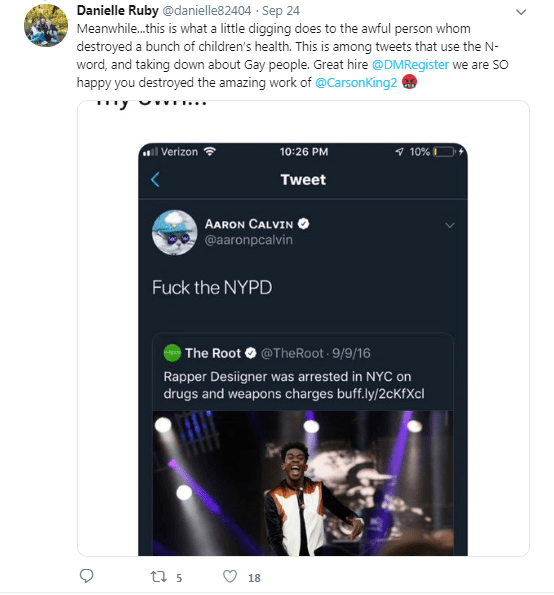
In the scouring of his twitter history, tweets surfaced dating from 2010 to 2013 that were also quite unsavory. These tweets included using a racist slur for black people, joked about abusing women, and mocking the legalization of same-sex marriage, among other things.
People soon flooded the Register’s statement on Twitter with screenshots of these offensive tweets.
Calvin set about deleting his old tweets, then tweeted out an apology for the tweets he deleted. After posting the apology, he then locked his account. The damage was done however, with doxxing and even death threats coming in for him. He called all of the backlash he was facing a “campaign taken up by right-wing idealogues”, and stated that he was getting a taste of what he “assumed women and journalists of color suffer all the time”.
In an interview with Buzzfeed he said Gannett, which owns the Register forbade him to speak to any media, and advised him to leave his apartment for the time being for his own safety. While speaking to police about the death threats he was receiving, he was again contacted by Gannett reps, and was given the choice to resign or be fired, with no severance. Calvin chose to be fired.
Calvin is still staying with a friend, afraid to go out in public. He isn’t so much angry over his dismissal as he is disappointed.
“Frankly, it’s really disappointing to me to be abandoned by my former employer,” he said. “I still in a lot of ways support the Register. I just wish they had believed in me.”
King himself holds no animosity towards the Register or Calvin. In a tweet he said they “had been nothing but kind in their coverage”. He was grateful that his old tweets were brought up to him so they could be addressed, as he believed it was the right thing to do. As for public support, King still has the love of the people.
Throughout the whole scandal, people on Twitter have universally given him their support, and other companies have stepped in to offer donations and promotions. Governor Kim Reynolds even declared Sept. 28 as “Carson King Day”, during which King was set to lead the “Hawkeye Wave”. The Venmo account also continued to grow.
At the close of the fundraiser at end of September, it ended with a total of $2.95 million. While the majority of the money will help pediatric patients, there isn’t a specific plan set for the donation yet. King is currently discussing potential uses for the money with the facility. This experience has him wanting to help other causes in the future, but he’d like to get back to a more normal life in the meantime.
“I’d like to start a foundation eventually and keep doing this for different hospitals and groups in Iowa and in the Midwest,” King said. “First I need to wrap this up and get back to a normal routine, get back to work and have a normal day and go from there.”
This whole scandal shines a light on cancel culture, with one person allegedly attempting to “cancel” a new celebrity, and in the end getting cancelled themselves. With Calvin’s experiences, receiving death threats and losing his job, a valuable lesson can be learned. With so much importance being placed on social media in modern times, every post made should be carefully considered to avoid offending someone and possibly sparking an online crusade.
While this solution may not be ideal, with the current cancel culture, it’s the best method to avoid sparking any further controversy.
 Call of the Lake
Leave a comment